
How to calculate overtime pay is straightforward for many hourly employees: determine the regular hourly rate, multiply it by 1.5 to find the standard time-and-a-half overtime rate, and multiply that rate by eligible overtime hours.
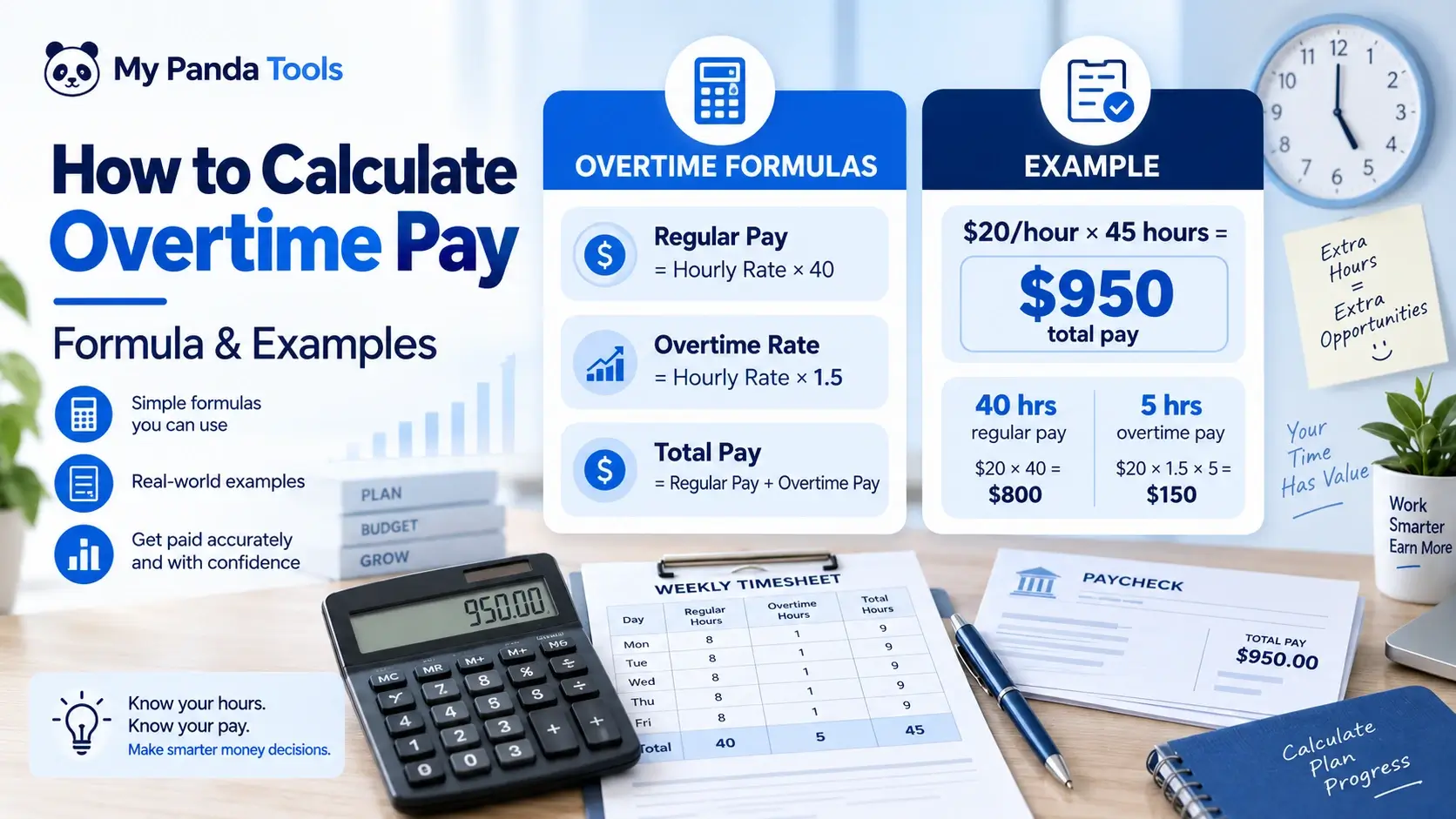
For example, if you earn $20 per hour and work 45 hours in a workweek, your standard overtime rate would be:
$20 × 1.5 = $30 per overtime hour
Five overtime hours would equal:
5 × $30 = $150 in overtime pay
Your regular earnings for the first 40 hours would be:
40 × $20 = $800
So your total gross weekly earnings would be:
$800 + $150 = $950
This basic calculation works well for many covered, nonexempt hourly employees with a single hourly rate. However, overtime calculations can become more complicated when bonuses, commissions, multiple rates of pay, salary arrangements, or different state overtime rules apply.
Under the federal Fair Labor Standards Act, covered, nonexempt employees generally must receive at least 1.5 times their regular rate of pay for hours worked over 40 in a workweek. The U.S. Department of Labor also makes clear that overtime is calculated by workweek rather than by averaging hours across multiple weeks.
This guide explains the overtime pay formula, how to calculate overtime hours, how biweekly payroll affects overtime, how taxes apply, and how the My Panda Tools Overtime Pay Calculator can simplify the process.
Quick Answer: How to Calculate Overtime Pay
For a typical hourly employee eligible for time-and-a-half overtime, use these formulas:
Overtime Rate = Regular Hourly Rate × 1.5
Overtime Hours = Hours Worked − 40
Overtime Pay = Overtime Hours × Overtime Rate
Total Weekly Gross Pay = Regular Pay + Overtime Pay
Suppose you earn:
$25 per hour
and work:
47 hours
First calculate overtime hours:
47 − 40 = 7 overtime hours
Then calculate the overtime rate:
$25 × 1.5 = $37.50
Overtime earnings:
7 × $37.50 = $262.50
Regular earnings:
40 × $25 = $1,000
Total gross weekly pay:
$1,000 + $262.50 = $1,262.50
That is the basic answer to how to calculate overtime pay for a standard time-and-a-half situation.
1. Understand the Federal Overtime Rule
Before using an overtime pay formula, determine whether federal overtime requirements apply to the employee.
Under the FLSA, covered employees who are not exempt generally receive overtime pay for hours worked beyond 40 during a workweek.
The federal rule is generally:
More than 40 hours in one workweek = at least 1.5 × the regular rate
A workweek is a fixed period of 168 consecutive hours, or seven consecutive 24-hour periods.
The employer’s workweek does not necessarily have to start Monday and end Sunday. It can begin on another day, but it must be a fixed and regularly recurring seven-day period.
The Department of Labor also states that hours generally cannot be averaged over two or more workweeks to avoid overtime.
For example:
Week 1:
45 hours
Week 2:
35 hours
Two-week total:
80 hours
An employer generally cannot simply say:
80 ÷ 2 = 40 hours per week, therefore no overtime
If the employee is covered and nonexempt, Week 1 can still contain 5 overtime hours.
This point becomes especially important when using a biweekly calculator.
2. Calculate Your Regular Hourly Rate
For many hourly workers, the regular hourly rate is simply the normal hourly wage.
If you earn:
$18 per hour
your regular rate may be:
$18
If you earn:
$25 per hour
your basic regular rate may be:
$25
However, the legal FLSA “regular rate” can include more than an employee’s stated hourly wage.
The Department of Labor explains that the regular rate generally includes compensation for employment unless a payment qualifies for a specific statutory exclusion. A simplified federal formula is:
Total includable compensation for the workweek ÷ Total hours worked = Regular Rate
This matters when an employee receives certain bonuses, commissions, shift payments, or other compensation.
For a basic employee receiving only one hourly wage, the stated hourly rate is usually the easiest starting point for a standard calculator estimate.
3. Use the Overtime Pay Formula
The standard overtime pay formula for time-and-a-half is:
Regular Hourly Rate × 1.5 = Overtime Rate
Suppose your normal rate is:
$22 per hour
Your overtime rate would be:
$22 × 1.5 = $33
If you work 6 overtime hours:
$33 × 6 = $198
Your overtime earnings would be:
$198
Regular 40-hour earnings:
$22 × 40 = $880
Total gross weekly earnings:
$880 + $198 = $1,078
This formula is the basis of a basic time and a half calculator.
4. Calculate Overtime Hours
To calculate overtime hours under the standard federal 40-hour rule:
Total Hours Worked − 40 = Overtime Hours
If you worked:
42 hours
Overtime hours:
42 − 40 = 2
If you worked:
48 hours
Overtime hours:
48 − 40 = 8
If you worked:
55 hours
Overtime hours:
55 − 40 = 15
Remember that this calculation assumes the employee is covered by the federal overtime rules and is not exempt.
State laws can sometimes require overtime under additional circumstances, so federal law should not automatically be treated as the only rule that applies.
5. Calculate Your Time and a Half Rate
A time and a half calculator simply multiplies the regular hourly rate by 1.5.
Here are several examples:
| Regular Hourly Rate | Time-and-a-Half Rate |
|---|---|
| $15.00 | $22.50 |
| $18.00 | $27.00 |
| $20.00 | $30.00 |
| $22.00 | $33.00 |
| $25.00 | $37.50 |
| $30.00 | $45.00 |
| $35.00 | $52.50 |
| $40.00 | $60.00 |
For someone earning $30 per hour:
$30 × 1.5 = $45
Therefore, the standard time-and-a-half overtime rate would be:
$45 per overtime hour
6. Calculate Overtime Pay After 40 Hours
The phrase overtime pay after 40 hours describes the standard federal rule for many covered, nonexempt workers.
Consider an employee earning:
$25 per hour
If They Work 45 Hours
Regular earnings:
40 × $25 = $1,000
Overtime hours:
5
Overtime rate:
$25 × 1.5 = $37.50
Overtime earnings:
5 × $37.50 = $187.50
Total:
$1,187.50
If They Work 50 Hours
Regular pay:
$1,000
Overtime hours:
10
Overtime earnings:
10 × $37.50 = $375
Total gross pay:
$1,375
This is why an hourly overtime calculator normally asks for at least three inputs:
Hourly rate + hours worked + overtime multiplier
7. Add Regular and Overtime Earnings
The final step in learning how to calculate overtime pay is combining regular wages and overtime wages.
Use:
Regular Pay + Overtime Pay = Total Gross Weekly Pay
Suppose:
Hourly rate = $30
Hours worked = 46
Regular pay:
40 × $30 = $1,200
Overtime rate:
$30 × 1.5 = $45
Overtime hours:
46 − 40 = 6
Overtime earnings:
6 × $45 = $270
Total gross pay:
$1,200 + $270 = $1,470
This is gross earnings before payroll taxes and other deductions.
Overtime Rate Calculator Examples
The table below shows how standard time-and-a-half calculations change at different hourly rates.
| Regular Rate | OT Rate | Gross Pay at 45 Hours | Gross Pay at 50 Hours |
|---|---|---|---|
| $15 | $22.50 | $712.50 | $825.00 |
| $20 | $30.00 | $950.00 | $1,100.00 |
| $25 | $37.50 | $1,187.50 | $1,375.00 |
| $30 | $45.00 | $1,425.00 | $1,650.00 |
| $35 | $52.50 | $1,662.50 | $1,925.00 |
| $40 | $60.00 | $1,900.00 | $2,200.00 |
These examples assume:
- One regular hourly rate
- Time-and-a-half overtime
- 40 regular hours
- No additional includable bonuses or commissions
More complicated compensation arrangements may require a different regular-rate calculation.
How Is Overtime Calculated?
If you are asking how is overtime calculated, there are two separate questions:
First:
How many overtime hours did you work?
Second:
What rate applies to those hours?
Under the standard federal calculation for a covered, nonexempt employee with a single hourly rate:
Hours above 40 = Overtime Hours
Then:
Regular Rate × 1.5 = Overtime Rate
For example:
Hourly wage:
$18
Total hours:
44
Overtime:
4 hours
Overtime rate:
$27
Overtime pay:
4 × $27 = $108
Regular pay:
40 × $18 = $720
Total:
$828
How to Calculate Overtime Rate of Pay
To calculate overtime rate of pay for standard time-and-a-half:
Regular Rate × 150%
or:
Regular Rate × 1.5
For example:
Regular rate:
$24
Overtime rate:
$24 × 1.5 = $36
If you worked eight overtime hours:
$36 × 8 = $288
Overtime earnings would be:
$288
Again, the legal “regular rate” may not always equal the stated hourly wage if additional includable compensation applies.
What Is an Overtime Pay Calculator?
An overtime pay calculator automates the arithmetic.
Instead of manually calculating:
- Regular hours
- Overtime hours
- Regular earnings
- Overtime rate
- Overtime earnings
- Total gross pay
you enter your pay information and let the calculator perform the conversion.
The My Panda Tools Overtime Pay Calculator can be useful for workers comparing schedules, estimating paychecks, checking overtime scenarios, and understanding how additional working hours may affect gross income.
However, a calculator result is an estimate. It cannot automatically determine every employee’s legal exemption status or every federal, state, local, union, or industry-specific payroll rule.
Pay Calculator With Overtime Example
Suppose you want a pay calculator with overtime estimate for this situation:
Hourly rate:
$28
Hours worked:
52
Regular pay:
40 × $28 = $1,120
Overtime hours:
52 − 40 = 12
Overtime rate:
$28 × 1.5 = $42
Overtime earnings:
12 × $42 = $504
Total gross earnings:
$1,120 + $504 = $1,624
The extra 12 hours increase gross weekly earnings by:
$504
Biweekly Pay and Overtime: Do Not Average the Hours
Biweekly payroll often causes confusion.
A biweekly paycheck normally covers two workweeks.
But overtime under the standard federal FLSA rule is generally calculated separately for each workweek.
Suppose your schedule is:
Week 1:
46 hours
Week 2:
34 hours
Total biweekly hours:
80
If you look only at the two-week total, it appears to average 40 hours per week.
However, Week 1 contains:
6 hours above 40
The Department of Labor says hours generally cannot be averaged over two or more weeks to avoid overtime requirements.
Therefore, a biweekly calculator that simply treats all 80 hours as regular time could give an incorrect overtime estimate.
A proper biweekly income calculation should first determine the earnings for each workweek.

Biweekly Overtime Example
Suppose you earn:
$20 per hour
Week 1:
45 hours
Week 2:
35 hours
Week 1
Regular pay:
40 × $20 = $800
Overtime rate:
$30
Overtime:
5 × $30 = $150
Week 1 total:
$950
Week 2
Regular earnings:
35 × $20 = $700
No hours exceed 40.
Week 2 total:
$700
Biweekly Gross Income
$950 + $700 = $1,650
Your biweekly income is therefore:
$1,650 gross
—not $1,600 based simply on 80 hours × $20.
Does Working on Saturday or Sunday Automatically Mean Overtime?
Not necessarily under federal law.
The FLSA does not automatically require overtime simply because someone works:
- Saturday
- Sunday
- Holiday
- Night shift
- Regular day off
Federal overtime generally depends on whether a covered, nonexempt worker exceeds 40 hours in the workweek.
The Department of Labor states that the FLSA does not itself require premium pay merely for weekend, holiday, or night work unless overtime requirements are otherwise triggered.
Employers, union agreements, contracts, or state law may provide additional premium-pay rules.
Is Overtime Always Time and a Half?
The federal baseline for covered, nonexempt employees is generally at least 1.5 times the regular rate after 40 hours.
Some employers or state rules may provide:
- Double time
- Daily overtime
- Weekend premiums
- Holiday premiums
- Other enhanced rates
Those additional rules should be evaluated separately.
A basic time and a half calculator should therefore be used only when 1.5 is the correct overtime multiplier.
How Bonuses Can Affect Overtime Pay
A common mistake when learning how to calculate overtime pay is assuming the regular hourly wage is always the only number that matters.
Some nondiscretionary bonuses and incentive payments may need to be included in the employee’s regular rate.
The Department of Labor says compensation generally must be included in the regular rate unless it qualifies for a statutory exclusion. Certain discretionary bonuses may be excluded, while nondiscretionary bonuses are often included.
For example, imagine an employee earns:
$20 per hour
works:
45 hours
and receives an includable:
$100 performance bonus
The regular-rate calculation may need to account for that bonus rather than simply applying $20 × 1.5.
This is an example of why actual payroll calculations can be more complicated than a basic overtime rate calculator.
Multiple Hourly Rates and Overtime
Some employees work different jobs for the same employer at different rates.
For example:
Job A:
$20 per hour
Job B:
$25 per hour
If the employee works both jobs during the same workweek and overtime applies, the calculation may involve a weighted average regular rate.
The Department of Labor explains that where an employee works at two or more straight-time rates in one workweek, the regular rate is generally based on the weighted average of those rates, subject to applicable FLSA rules.
Therefore, simply multiplying the higher or lower hourly wage by 1.5 may not always produce the correct answer.
Salaried Employees and Overtime
Being paid a salary does not automatically mean an employee is exempt from overtime.
Overtime eligibility depends on applicable legal requirements and the employee’s actual employment situation.
Some salaried workers may be exempt, while other salaried workers may still be entitled to overtime.
The calculation can also differ depending on how the salary is structured and what hours it is intended to compensate.
Because of this, a basic hourly overtime calculator should not automatically be used to determine legal overtime obligations for every salaried worker.
If classification or salary-based overtime is unclear, official Department of Labor guidance or qualified payroll/legal advice is more appropriate.
Overtime Pay and Taxes in 2026
Overtime income is still wages.
Employers generally withhold federal income tax and employment taxes from overtime compensation.
The IRS explains that federal income-tax withholding depends on earnings and Form W-4 information. Overtime compensation also generally remains subject to Social Security and Medicare taxes.
However, there is an important federal tax change relevant in 2026.
For tax years beginning after 2024 and before 2029, federal law allows eligible taxpayers a deduction for certain qualified overtime compensation.
The IRS states that the deduction can be up to:
$12,500 for an individual
or:
$25,000 for married taxpayers filing jointly
subject to applicable income limitations.
Importantly, this does not mean all overtime wages are tax-free.
The IRS says qualified overtime for this deduction generally means the portion of overtime compensation above the regular rate that is required under Section 7 of the FLSA.
For a standard time-and-a-half example:
Regular rate:
$20
Overtime rate:
$30
The additional premium above the regular rate is:
$10
That extra “half-time” component may potentially qualify under the federal deduction rules when all requirements are met.
The entire $30 overtime rate should not automatically be assumed to qualify.
The deduction also does not eliminate normal payroll-tax treatment or payroll withholding.
Is Overtime Taxed More Than Regular Pay?
A larger paycheck can sometimes have more tax withheld, leading employees to believe overtime has a special higher tax rate.
But overtime is generally part of wage income.
Federal withholding depends on payroll withholding methods, earnings, and Form W-4 information.
The amount withheld from one paycheck is also not necessarily the same as the employee’s final annual income-tax liability.
For 2026, the qualified-overtime deduction described above may reduce taxable income for eligible taxpayers, but it does not mean overtime is excluded from wages altogether.
Use the IRS Tax Withholding Estimator if you want a more individualized federal withholding estimate.
How to Calculate Overtime Pay After Taxes
A general estimate is:
Gross Pay − Taxes − Benefits − Other Deductions = Net Pay
But there is no universal percentage you can subtract to accurately determine every worker’s after-tax overtime pay.
Take-home pay can depend on:
- Federal withholding
- Form W-4
- Social Security
- Medicare
- State income taxes
- Local taxes
- Benefits
- Retirement deductions
- Other payroll deductions
Therefore, a pay calculator with overtime can estimate gross wages accurately when the inputs are correct, but a net-pay calculation requires more personal payroll information.
Common Overtime Calculation Mistakes
Using Total Biweekly Hours Instead of Each Workweek
An employee who works 45 hours one week and 35 the next may still have overtime in the first week.
Do not automatically average the two weeks.
Multiplying All Hours by 1.5
Only qualifying overtime hours should normally receive the overtime premium under the basic calculation.
For example, with 45 hours at $20:
Incorrect:
45 × $30 = $1,350
Basic correct calculation:
40 × $20 + 5 × $30 = $950
Using the Wrong Regular Rate
Certain bonuses, commissions, or multiple pay rates can affect the legal regular rate.
Assuming Weekends Automatically Mean Overtime
Federal law does not automatically require overtime merely because the work occurs on Saturday or Sunday.
Confusing Gross and Net Overtime Pay
The overtime formula normally calculates gross wages.
Take-home pay is lower after applicable deductions.
Averaging Hours Across Pay Periods
Overtime is generally determined by workweek under the FLSA, not by averaging two or more weeks.
Assuming Every Employee Qualifies
Some employees may be exempt from federal overtime requirements.
Ignoring State Rules
Some states have overtime requirements that provide greater protections than the federal baseline.
Why Your Overtime Calculator Result May Differ From Your Pay Stub
An overtime pay calculator provides an estimate based on the values you enter.
Your actual payroll result could differ because of:
- Bonuses
- Commissions
- Shift differentials
- Multiple hourly rates
- Paid leave
- Employer pay policies
- State overtime rules
- Rounding procedures
- Payroll deductions
- Employee classification
Compare gross earnings first before comparing take-home amounts.
Use the My Panda Tools Overtime Pay Calculator
The My Panda Tools Overtime Pay Calculator can simplify routine overtime estimates.
Instead of calculating each step manually, enter your:
Hourly rate → hours worked → overtime multiplier
and review your estimated regular pay, overtime pay, and total gross income.
This can help when you want to:
- Estimate your next paycheck
- Compare different work schedules
- Calculate overtime hours
- Find your time-and-a-half rate
- Estimate overtime pay after 40 hours
- Compare regular and overtime earnings
- Understand how extra shifts affect weekly pay
You can also use related My Panda Tools salary calculators when comparing weekly, biweekly, hourly, and annual income.
Overtime Pay Calculator vs. Biweekly Calculator
These two calculators answer different questions.
An overtime pay calculator helps determine:
How much extra compensation comes from overtime hours?
A biweekly calculator helps determine:
How much income will I receive across a two-week pay period?
If overtime is involved, calculate each workweek correctly first and then add the weekly results together to estimate biweekly income.
This avoids the mistake of averaging overtime hours across two weeks.
Final Answer: How to Calculate Overtime Pay
The easiest answer to how to calculate overtime pay for a standard time-and-a-half hourly situation is:
Step 1: Calculate overtime hours
Hours Worked − 40 = Overtime Hours
Step 2: Calculate overtime rate
Regular Hourly Rate × 1.5 = Overtime Rate
Step 3: Calculate overtime earnings
Overtime Hours × Overtime Rate = Overtime Pay
Step 4: Calculate total gross pay
Regular Pay + Overtime Pay = Total Gross Earnings
For example:
Hourly rate:
$20
Hours worked:
45
Regular earnings:
40 × $20 = $800
Overtime rate:
$20 × 1.5 = $30
Overtime pay:
5 × $30 = $150
Total:
$950 gross
This standard formula is useful for basic calculations, but actual overtime rules can be more complex when bonuses, commissions, multiple rates, salary arrangements, exemptions, state laws, or other compensation are involved.
For a quick estimate, use the My Panda Tools Overtime Pay Calculator and enter your hourly rate and work hours.
Frequently Asked Questions
How do I calculate overtime pay?
For a standard time-and-a-half calculation, multiply the regular hourly rate by 1.5. Then multiply that overtime rate by the number of eligible overtime hours.
For example:
$20 × 1.5 = $30 overtime rate
Five overtime hours:
$30 × 5 = $150 overtime pay
How is overtime calculated after 40 hours?
For a covered, nonexempt employee under the standard federal rule, subtract 40 from total workweek hours to determine overtime hours and pay those overtime hours at no less than 1.5 times the regular rate.
What is the overtime pay formula?
The basic formula is:
Overtime Pay = Overtime Hours × Regular Rate × 1.5
This formula works for straightforward time-and-a-half situations where the stated hourly wage is the applicable regular rate.
What is time and a half for $20 an hour?
Calculate:
$20 × 1.5 = $30
Time and a half for $20 per hour is $30 per hour.
What is time and a half for $25 an hour?
$25 × 1.5 = $37.50
The standard overtime rate is $37.50 per hour.
What is time and a half for $30 an hour?
$30 × 1.5 = $45
The standard overtime rate is $45 per hour.
Can overtime be averaged over two weeks?
Generally, not under the standard FLSA rule. Overtime is normally determined separately for each workweek. Working 45 hours one week and 35 the next does not automatically eliminate the five overtime hours from the first week.
Is overtime calculated differently on biweekly pay?
The paycheck may cover two weeks, but standard federal overtime is generally calculated separately for each workweek. After calculating each week’s earnings, the amounts can be combined to determine biweekly gross income.
Is overtime tax free in 2026?
No. Overtime wages generally remain subject to withholding and employment taxes. However, eligible taxpayers may claim a federal deduction for certain qualified FLSA overtime premium compensation, subject to statutory limits and income restrictions.
Can salaried employees receive overtime?
Yes, some salaried employees can be eligible for overtime. Being paid a salary alone does not automatically establish overtime exemption. Eligibility depends on applicable federal and state rules and the employee’s circumstances.
My Panda Tools calculators and educational content are provided for general informational purposes only. Calculator results are estimates and are not payroll, tax, employment, accounting, financial, or legal advice. Actual overtime eligibility, regular rates, bonuses, deductions, state requirements, exemptions, and tax treatment depend on the worker’s circumstances and applicable federal, state, and local laws.