
How to calculate a house payment starts with more than simply looking at a home’s sale price. Your actual monthly housing cost can include mortgage principal, interest, property taxes, homeowners insurance, mortgage insurance, and sometimes HOA or condominium fees.
For example, a mortgage calculator may show a principal and interest payment of $2,000 per month, but your real housing cost could be several hundred dollars higher after taxes and insurance are included.
That difference matters when you’re asking questions such as “how much mortgage can I afford?”, “what house can I afford?”, or deciding whether a particular property fits comfortably into your monthly budget.
This guide explains the house payment formula step by step, shows real examples, explains affordability, and helps you understand how a mortgage affordability calculator or house affordability calculator can help during the home-buying process.
You can also use the mortgage and financial calculators available at My Panda Tools to quickly compare different home prices, down payments, mortgage rates, and loan terms.
Quick Answer: How to Calculate a House Payment
A typical monthly house payment can include:
Principal + Interest + Property Taxes + Homeowners Insurance + Mortgage Insurance = Estimated Monthly House Payment
These four basic mortgage components are often described as PITI:
- P – Principal
- I – Interest
- T – Taxes
- I – Insurance
The Consumer Financial Protection Bureau identifies principal, interest, taxes, and insurance as the basic elements commonly associated with a monthly mortgage payment.
You may also need to budget separately for:
- HOA fees
- Condo fees
- Utilities
- Maintenance
- Repairs
- Flood insurance
- Other property related expenses
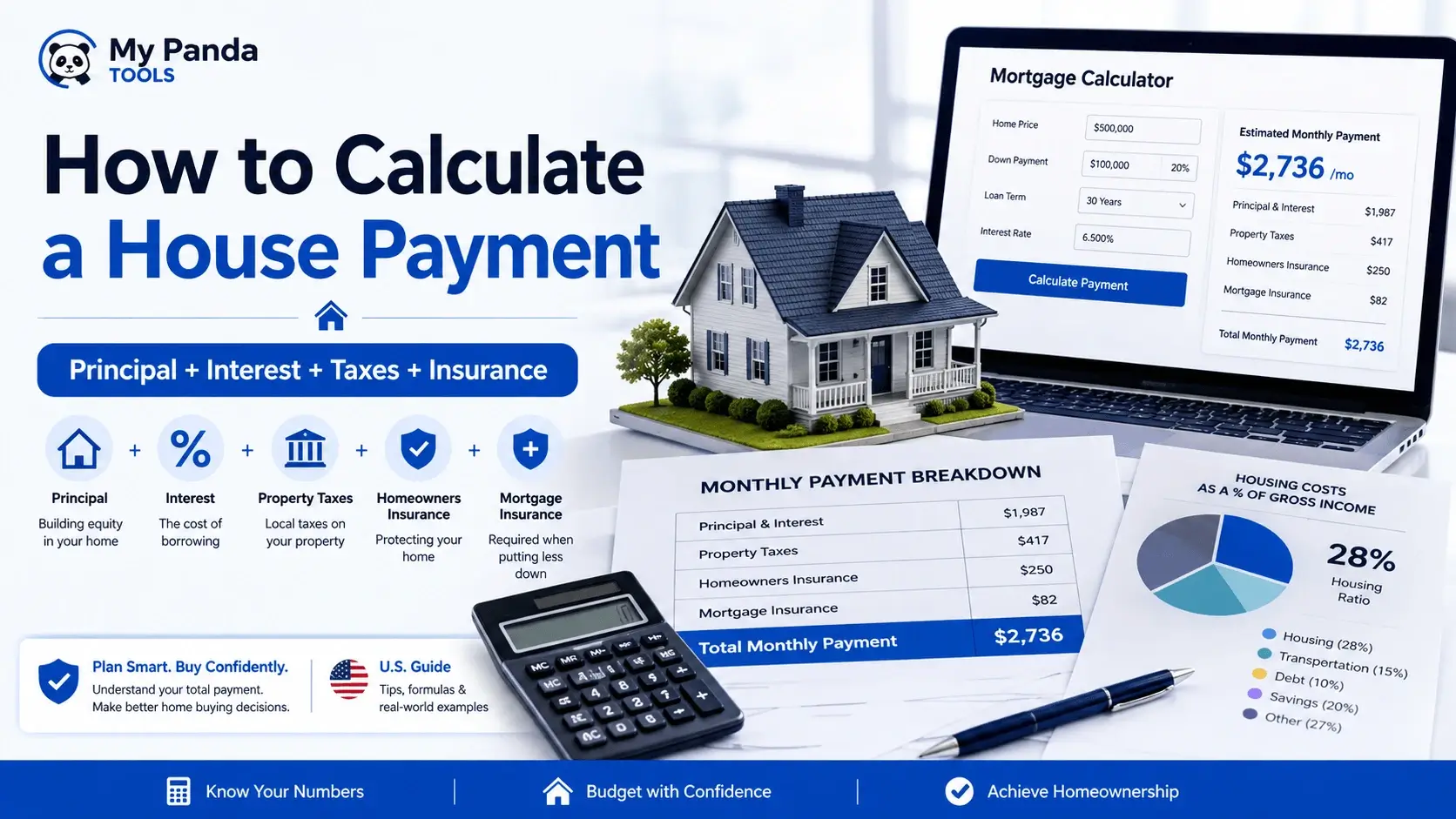
Therefore, when deciding whether you can afford a home, do not look only at the mortgage principal and interest.
7 Smart Steps: How to Calculate a House Payment
Step 1: Determine the Home Price
Start with the purchase price of the property.
Suppose you are considering a home priced at:
$400,000
The home price is not automatically the amount you will borrow because your down payment reduces the mortgage principal.
For affordability planning, consider several price points instead of calculating only one home.
For example:
- $300,000
- $350,000
- $400,000
- $450,000
Running multiple scenarios can give you a better understanding of which price range fits your budget.
Step 2: Subtract Your Down Payment
The next step in understanding how to calculate a house payment is finding your estimated loan amount.
Use:
Home Price − Down Payment = Mortgage Loan Amount
Suppose:
Home price = $400,000
Down payment = $80,000
Then:
$400,000 − $80,000 = $320,000
Your estimated mortgage principal would be:
$320,000
A larger down payment generally reduces the amount you need to finance.
For example:
| Home Price | Down Payment | Estimated Loan |
|---|---|---|
| $400,000 | $40,000 | $360,000 |
| $400,000 | $60,000 | $340,000 |
| $400,000 | $80,000 | $320,000 |
| $400,000 | $100,000 | $300,000 |
A smaller loan generally produces a lower principal-and-interest payment when the loan term and interest rate remain the same.
Your down payment may also affect mortgage-insurance requirements.
Step 3: Choose a Mortgage Interest Rate
Your mortgage rate is one of the most important factors affecting your monthly payment.
Suppose you borrow:
$320,000
with a:
30-year fixed mortgage
The estimated principal and interest payment changes considerably at different rates.
Approximately:
| Interest Rate | Monthly Principal & Interest |
|---|---|
| 5.5% | $1,817 |
| 6.0% | $1,919 |
| 6.5% | $2,023 |
| 7.0% | $2,129 |
| 7.5% | $2,238 |
These are approximate principal-and-interest calculations.
They do not include taxes, homeowners insurance, mortgage insurance, or HOA fees.
This is why you should use a realistic rate when using a mortgage affordability calculator. The CFPB notes that the interest rate is one of the key factors determining the home price a buyer may be able to afford.
Do not assume the lowest advertised mortgage rate will automatically be available to you.
Your actual rate can depend on your financial profile, loan program, lender, down payment, loan term, and market conditions.
Step 4: Select Your Mortgage Term
Common home-loan terms include:
- 15 years
- 20 years
- 30 years
A longer mortgage term generally lowers the required monthly principal-and-interest payment because repayment is spread over more months.
However, it can also mean paying interest for longer.
A shorter mortgage term generally creates a higher monthly payment but may reduce total interest costs over the life of the loan.
For example, suppose you borrow $300,000.
A 30 year mortgage will normally have a lower required monthly principal-and-interest payment than a 15-year mortgage at the same interest rate.
But the 15-year loan pays the principal down more quickly.
When asking “how much mortgage can I afford?”, do not automatically choose the loan term that creates the smallest monthly payment. Consider both monthly affordability and long-term borrowing costs.
House Payment Formula for Principal and Interest
For a standard fixed-rate mortgage, monthly principal and interest can be estimated using this formula:
M = P × [r(1 + r)ⁿ] ÷ [(1 + r)ⁿ − 1]
Where:
M = monthly principal-and-interest payment
P = mortgage principal
r = monthly interest rate
n = total number of monthly payments
Suppose:
Loan amount = $320,000
Annual interest rate = 6.5%
Loan term = 30 years
First convert the annual interest rate into a monthly decimal rate:
0.065 ÷ 12 = 0.0054167
Next calculate the number of monthly payments:
30 × 12 = 360 payments
After applying the mortgage formula, estimated monthly principal and interest is approximately:
$2,022.62
Lenders generally use a standard mathematical formula based on loan amount, loan term, and interest rate to calculate the principal-and-interest portion of a fixed-rate mortgage.
But this is not necessarily your complete monthly house payment.
Step 5: Add Property Taxes
Property taxes are an important part of determining how to calculate a house payment accurately.
Property-tax rates and assessments vary considerably by location.
Suppose the annual property tax on a home is:
$6,000
Convert this to a monthly estimate:
$6,000 ÷ 12 = $500
Estimated monthly property tax:
$500
Now add this to the principal-and-interest payment.
Using the previous example:
Principal and interest = $2,022.62
Property taxes = $500
Subtotal:
$2,522.62 per month
Property taxes may change over time, so they should not be treated as a permanently fixed cost.
Step 6: Add Homeowners Insurance and Mortgage Insurance
Homeowners insurance should also be included when calculating affordability.
Suppose your estimated annual homeowners insurance premium is:
$1,800
Divide by 12:
$1,800 ÷ 12 = $150
Estimated monthly insurance cost:
$150
Add that to our example:
Principal and interest = $2,022.62
Property tax = $500
Homeowners insurance = $150
Estimated payment:
$2,672.62 per month
If mortgage insurance applies, that expense should also be included.
The CFPB emphasizes that total monthly mortgage payments are usually higher than principal and interest because taxes, homeowners insurance, and potentially mortgage insurance may also apply.
Step 7: Add HOA Fees and Other Housing Costs
Suppose the home is part of a homeowners association that charges:
$150 per month
Your practical monthly housing budget becomes:
Principal and interest = $2,022.62
Property tax = $500
Homeowners insurance = $150
HOA fee = $150
Total estimated monthly housing cost:
$2,822.62
This example demonstrates why a home can appear affordable when looking only at the mortgage payment but become much more expensive after ownership costs are included.
The CFPB also identifies HOA fees, maintenance, utilities, taxes, and insurance as relevant factors when estimating how much home a buyer can afford.
Full House Payment Example
Let’s calculate a complete example.
Home Details
Home price:
$400,000
Down payment:
$80,000
Loan amount:
$320,000
Mortgage rate:
6.5%
Mortgage term:
30 years
Estimated principal and interest:
$2,022.62
Estimated monthly property tax:
$500
Estimated homeowners insurance:
$150
Estimated HOA:
$150
The estimated monthly housing cost is:
$2,022.62 + $500 + $150 + $150
= $2,822.62
Remember that this remains an estimate.
Actual taxes, insurance, loan costs, mortgage insurance, HOA assessments, and lender terms can differ.
How Much Mortgage Can I Afford?
If you are asking “how much mortgage can I afford?”, start with your monthly budget instead of starting with the maximum loan a lender may approve.
There is an important difference between:
How much you can qualify to borrow
and
How much you can comfortably afford to repay
The CFPB specifically advises buyers to focus on a mortgage that fits their own priorities rather than simply relying on the maximum amount a lender says they qualify to borrow.
Your household budget may include expenses that a basic mortgage qualification calculation cannot fully understand.
Consider:
- Auto loans
- Credit cards
- Student loans
- Childcare
- Healthcare
- Groceries
- Transportation
- Utilities
- Insurance
- Emergency savings
- Retirement savings
- Travel
- Family expenses
- Home maintenance
A mortgage payment that technically qualifies under lender guidelines can still feel uncomfortable if it leaves too little room for these priorities.
What House Can I Afford?
When asking “what house can I afford?”, work backward from a monthly housing budget.
Suppose you decide that you can comfortably spend:
$2,800 per month
on housing.
Estimated monthly non-loan housing expenses:
Property taxes = $450
Homeowners insurance = $150
HOA fees = $100
Total:
$700
Subtract those costs:
$2,800 − $700 = $2,100
That leaves approximately:
$2,100 per month
for principal and interest.
You can then use a mortgage calculator to determine approximately how large a loan corresponds to a $2,100 monthly principal and interest budget at your expected interest rate and loan term.
Finally:
Affordable Loan Amount + Down Payment = Approximate Affordable Home Price
This is broadly consistent with the CFPB’s affordability approach: start with the total monthly amount you can afford, estimate taxes and insurance, subtract those expenses, and determine the loan amount that fits the remaining principal-and-interest budget.
How Much House Can I Afford Calculator What Inputs Matter?
A good how much house can I afford calculator should consider more than income.
Important inputs include:
Gross Monthly Income
Gross income is your income before taxes and deductions.
If your annual gross income is $96,000:
$96,000 ÷ 12 = $8,000 gross monthly income
Monthly Debt Payments
This can include recurring debt obligations such as:
- Auto loans
- Student loans
- Credit-card obligations
- Personal loans
- Other recurring debt payments
Down Payment
The amount available for a down payment changes how much you need to borrow.
Mortgage Rate
Higher mortgage rates generally mean a higher monthly payment for the same loan amount.
Loan Term
A 15-year and 30-year mortgage can produce very different monthly payments.
Property Taxes
These vary by property and location.
Homeowners Insurance
Insurance premiums also vary based on the property, location, coverage, insurer, and other factors.
Mortgage Insurance
This may apply depending on the loan program and down payment.
HOA Fees
HOA or condominium fees can materially increase monthly housing costs.
A useful house affordability calculator should combine these variables instead of relying on home price alone.
Debt to Income Ratio and Mortgage Affordability
Mortgage lenders commonly consider your debt-to-income ratio, often abbreviated as DTI.
A simple DTI formula is:
Monthly Debt Payments ÷ Gross Monthly Income × 100
Suppose your gross monthly income is:
$8,000
and your relevant monthly debt obligations total:
$2,800
Then:
$2,800 ÷ $8,000 × 100 = 35%
Your DTI would be approximately:
35%
However, there is no single DTI percentage that guarantees mortgage approval for every borrower.
Lender requirements can vary according to the mortgage program, underwriting criteria, borrower characteristics, and other factors.
A mortgage affordability calculator should therefore be used for planning rather than as a guaranteed loan-approval tool.
House Affordability Calculator vs. Mortgage Calculator
These calculators answer related but different questions.
Mortgage Calculator
A mortgage calculator generally answers:
“What will my payment be if I borrow this amount?”
You enter:
- Loan amount
- Interest rate
- Loan term
The calculator returns estimated principal and interest.
More advanced calculators may also include property taxes and insurance.
House Affordability Calculator
A house affordability calculator answers:
“How expensive a home might fit my budget?”
It may use:
- Income
- Existing debts
- Down payment
- Interest rate
- Property taxes
- Insurance
- Loan term
- Monthly housing budget
This makes an affordability calculator useful earlier in the home-buying process.
Mortgage Affordability Calculator Why Interest Rates Matter
Suppose you can comfortably allocate about $2,000 per month toward principal and interest.
The mortgage balance supported by that payment changes depending on the interest rate.
When rates rise, the same monthly budget generally supports a smaller loan.
When rates fall, that same monthly budget may support a larger loan.
This is why a home price that fits your budget at one mortgage rate may not fit at another.
When using a mortgage affordability calculator, test more than one interest-rate scenario.
For example:
- Expected rate
- Expected rate + 0.5%
- Expected rate + 1%
This creates a more realistic affordability range instead of relying on one optimistic estimate.
How a Down Payment Changes House Affordability
Suppose you have calculated that you can comfortably support a:
$300,000 mortgage
If your available down payment is:
$30,000
your theoretical purchase-price range might be around:
$330,000
If your down payment is:
$70,000
the approximate price might be:
$370,000
This is simplified because closing costs and other upfront expenses must also be considered.
Do not use every available dollar for the down payment without considering whether you will still have enough money for closing costs, moving expenses, emergency savings, repairs, furnishings, and unexpected homeownership expenses.
Fixed Rate vs. Adjustable Rate House Payments
With a traditional fixed-rate mortgage, the interest rate remains fixed throughout the loan term.
Therefore, scheduled principal and interest generally remain predictable.
However, your total monthly housing payment can still change if:
- Property taxes increase
- Homeowners insurance changes
- Mortgage insurance changes
- HOA fees increase
An adjustable-rate mortgage, or ARM, operates differently.
The mortgage interest rate may change after the introductory fixed-rate period according to the loan terms.
That means your future principal-and-interest payment may also change.
When determining how much house can I afford, consider not only the introductory ARM payment but also whether you could handle potential future increases.
Common Mistakes When Calculating a House Payment
Looking Only at Principal and Interest
This is one of the biggest affordability mistakes.
A mortgage calculator may say $2,000 per month while the total housing cost becomes $2,700 after taxes, insurance, and HOA fees.
Ignoring Property Taxes
Tax bills vary substantially by property and location.
Always investigate realistic taxes for the home you are considering.
Forgetting Homeowners Insurance
Insurance is another ongoing homeownership cost and may be included through escrow.
Ignoring Mortgage Insurance
Depending on your loan and down payment, mortgage insurance may increase monthly costs.
Forgetting HOA Fees
HOA fees are commonly paid separately from the mortgage but still reduce the amount available in your household budget.
Using an Unrealistically Low Interest Rate
Calculate your payment using a realistic mortgage rate instead of the lowest rate you have seen advertised.
Spending the Maximum Amount a Lender Approves
The maximum mortgage you qualify for may not be the amount that fits comfortably within your personal budget.
Forgetting Maintenance and Repairs
Mortgage payments are only part of homeownership.
Roofs, HVAC systems, appliances, plumbing, electrical systems, and other parts of a home may eventually require maintenance or replacement.
Should You Use the 28% Rule?
You may see general home-affordability advice suggesting that housing costs should stay around a certain percentage of gross monthly income.
Such guidelines can provide a rough starting point, but they should not be treated as universal mortgage rules.
Two households earning identical incomes may have completely different financial situations.
One may have:
- No consumer debt
- Large emergency savings
- Low childcare costs
while another may have:
- Student loans
- Auto payments
- Childcare expenses
- Medical expenses
That is why a personalized household budget and lender-specific underwriting are more reliable than assuming one percentage applies to everyone.
How to Know Whether a House Payment Is Comfortable
Ask yourself several questions before committing to a mortgage.
Can I make the payment comfortably every month?
Can I continue saving for retirement?
Can I maintain an emergency fund?
Can I handle major home repairs?
Can I manage the payment if insurance or property taxes increase?
Can I still meet other financial obligations?
Would the payment still be manageable if household income temporarily decreased?
These questions help turn a basic how much house can I afford calculator result into a more realistic financial decision.
Use My Panda Tools to Estimate Your House Payment
Manual mortgage formulas are useful for understanding how house payments work, but calculating multiple scenarios manually can become time-consuming.
With My Panda Tools, you can quickly compare mortgage scenarios using different:
- Home prices
- Loan amounts
- Down payments
- Mortgage rates
- Loan terms
Try calculating several combinations instead of relying on a single estimate.
For example, compare:
Scenario A: $350,000 home with 10% down
Scenario B: $350,000 home with 20% down
Scenario C: $400,000 home with 20% down
Scenario D: Same home with a 0.5% higher mortgage rate
This can help you understand which variable has the greatest impact on your monthly payment.
You can also explore other My Panda Tools Financial Calculators for additional budgeting and financial calculations.
Final Answer: How to Calculate a House Payment
To understand how to calculate a house payment, begin with:
Home Price − Down Payment = Mortgage Amount
Then calculate principal and interest using:
- Loan amount
- Mortgage interest rate
- Loan term
After that, add:
- Property taxes
- Homeowners insurance
- Mortgage insurance, if applicable
- HOA or condo fees when relevant
For example:
Principal and interest = $2,022.62
Property taxes = $500
Insurance = $150
HOA = $150
Estimated monthly housing cost:
$2,822.62
When deciding how much mortgage can I afford, do not base your decision only on how much a lender may approve.
Look at your income, debts, savings goals, family expenses, maintenance costs, emergency savings, and overall monthly budget.
A mortgage affordability calculator or house affordability calculator can provide a useful estimate, but the final decision should be based on your complete financial situation.
Frequently Asked Questions About House Payments
How do you calculate a house payment?
Start by subtracting your down payment from the home price to determine the loan amount. Calculate principal and interest using the mortgage rate and term, then add estimated property taxes, homeowners insurance, mortgage insurance if applicable, and other recurring property costs.
What is included in a monthly house payment?
A monthly mortgage payment commonly includes principal, interest, property taxes, and homeowners insurance. Mortgage insurance may also apply. HOA or condominium fees are often separate but should still be included when planning your housing budget.
How much mortgage can I afford?
The answer depends on your income, current debts, down payment, interest rate, loan term, taxes, insurance, credit profile, and personal spending priorities. A mortgage affordability calculator can provide an estimate, but it is not a guarantee of lender approval.
What house can I afford based on my salary?
Salary is only one factor. You should also consider existing debt obligations, down payment, taxes, insurance, mortgage rate, savings, household expenses, and the monthly payment you can comfortably maintain.
How does a how much house can I afford calculator work?
A how much house can I afford calculator typically combines income, debts, down payment, mortgage rate, loan term, taxes, insurance, and other housing costs to estimate an affordable home-price range.
Does a mortgage calculator include taxes and insurance?
Not always. Some mortgage calculators calculate only principal and interest. Check the results carefully and add taxes, insurance, mortgage insurance, and HOA costs when those expenses are not included.
Does a larger down payment lower my house payment?
Generally, yes. A larger down payment reduces the mortgage principal, which normally reduces principal and interest when the interest rate and term remain unchanged. It may also affect mortgage-insurance requirements.
How does the mortgage rate affect house affordability?
A higher interest rate normally increases the monthly principal-and-interest payment for the same loan amount. That means a higher rate can reduce the home price that fits within the same monthly budget.
Is the maximum mortgage I qualify for the amount I should spend?
Not necessarily. The amount a lender is willing to finance may be greater than the amount that comfortably fits your lifestyle, savings goals, and household expenses.
What is the best way to estimate how much house I can afford?
Start with a monthly payment you can comfortably maintain. Estimate taxes, insurance, HOA fees, and other homeownership costs. Then determine how much principal and interest fits within the remaining budget and use a house affordability calculator to estimate a corresponding home price range.