
Auto loan rates by credit score can vary dramatically in 2026. Based on Experian’s Q1 2026 automotive finance data, average APRs ranged from 4.55% to 16.01% for new cars and from 6.30% to 21.77% for used cars, depending on the borrower’s credit tier.
Across all borrowers, the average auto loan interest rate in Q1 2026 was 6.39% for a new vehicle and 11.43% for a used vehicle. Those figures are market averages not guaranteed rates for an individual applicant.
Your actual auto loan APR can depend on much more than your credit score. Lenders may also consider your credit history, income, existing debt, loan amount, down payment, repayment term, vehicle type, and whether the vehicle is new or used.
That means two borrowers with similar credit scores can receive different offers.
This 2026 guide breaks down car loan rates by credit score, explains the difference between new and used car financing, shows how APR changes your monthly payment, and explains how taxes, trade ins, down payments, and negative equity affect your actual amount financed.
You can also use the My Panda Tools Auto Loan Calculator to compare loan scenarios before visiting a dealership or accepting a financing offer.
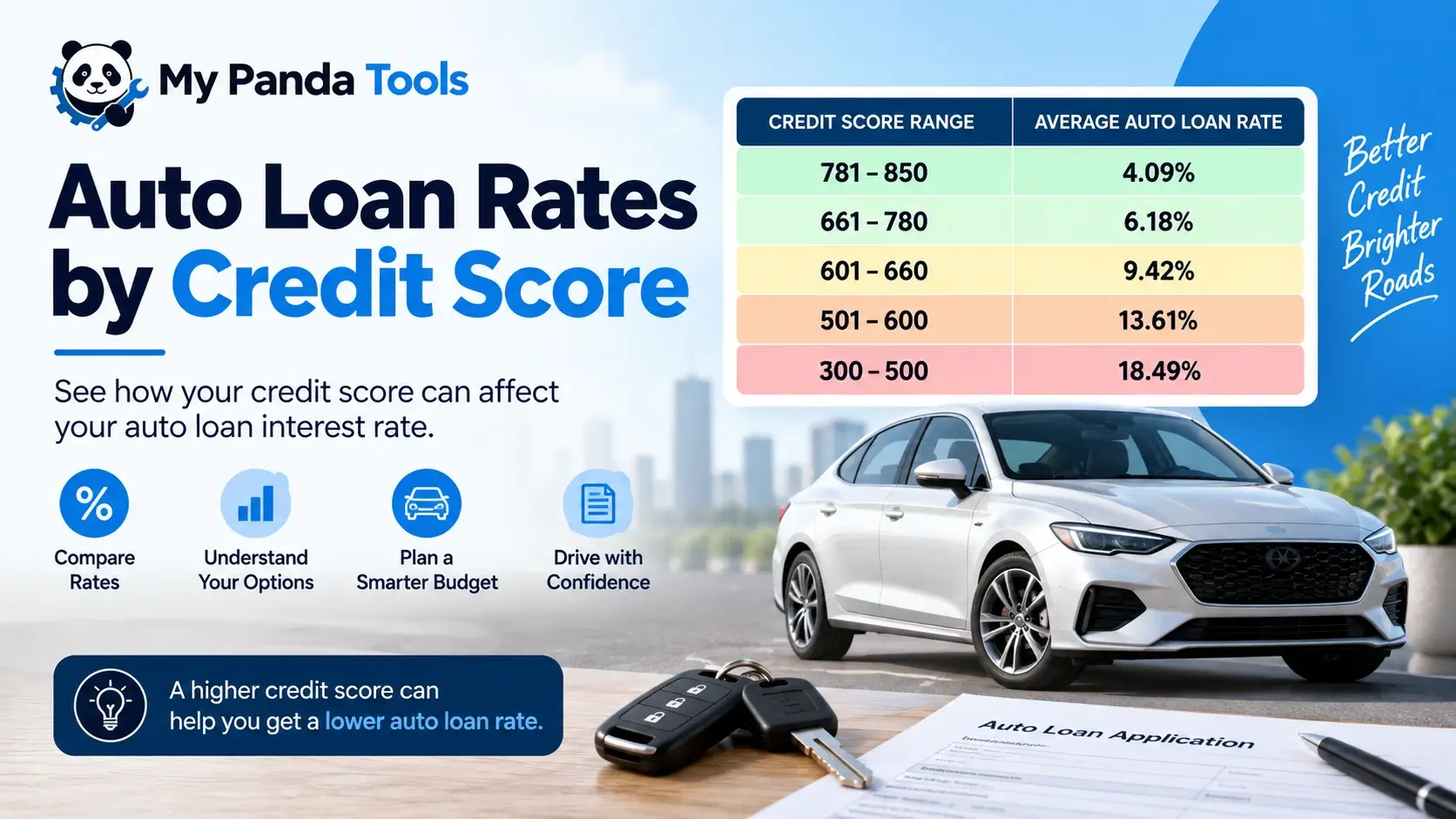
Quick Answer: Auto Loan Rates by Credit Score in 2026
The latest detailed 2026 credit tier data publicly available from Experian uses VantageScore 4.0 and reports these average APRs for Q1 2026:
| Credit Tier | Credit Score | New Car APR | Used Car APR |
|---|---|---|---|
| Super Prime | 781–850 | 4.55% | 6.30% |
| Prime | 661–780 | 6.23% | 8.77% |
| Near Prime | 601–660 | 9.67% | 14.03% |
| Subprime | 501–600 | 13.44% | 19.42% |
| Deep Subprime | 300–500 | 16.01% | 21.77% |
Source: Experian State of the Automotive Finance Market, Q1 2026; VantageScore 4.0.
These are averages—not advertised minimum rates or guaranteed offers.
Experian has also released its Q2 2026 automotive finance market report, but its public summary does not provide the same complete APR by credit tier table. For that reason, the table above should be clearly labeled as Q1 2026 data rather than presented as a live September 2026 rate sheet.
1. Auto Loan Rates by Credit Score: Why Your Score Matters
Your credit score helps a lender estimate lending risk.
In general, borrowers with stronger credit histories tend to receive lower auto loan rates because lenders consider them less likely to miss payments or default.
Borrowers with weaker credit may still qualify for financing, but they often face substantially higher APRs.
For example, Experian’s Q1 2026 data shows:
Super prime new car borrower: 4.55% average APR
Deep subprime new car borrower: 16.01% average APR
For used cars:
Super prime borrower: 6.30%
Deep subprime borrower: 21.77%
That is a major difference in borrowing cost.
However, credit score is not the only factor.
The Consumer Financial Protection Bureau explains that lenders may also consider:
- Credit history
- Income
- Existing debts
- Loan amount
- Loan term
- Down payment
- Vehicle type
- Whether the car is new or used
So your credit score provides a useful starting point, but it cannot tell you your exact rate before a lender evaluates your application.
2. Average Auto Loan Interest Rate in 2026
According to Experian’s Q1 2026 data, the overall averages were:
New Cars
Average APR: 6.39%
Average amount financed:
$43,925
Average monthly payment:
$770
Average loan term:
69.48 months
Average borrower credit score:
751
Used Cars
Average APR: 11.43%
Average amount financed:
$27,070
Average monthly payment:
$531
Average loan term:
67.73 months
Average borrower credit score:
682
These averages show an important pattern: used car loan rates are substantially higher than new car loan rates on average, even though used vehicles usually involve smaller loan balances.
Rates also continue to move during the year. For example, later market reporting cited by NerdWallet placed July 2026 average APRs at approximately 7.0% for new vehicles and 10.6% for used vehicles based on Edmunds data. Those figures are overall market averages and are not broken down by credit tier.
Therefore, use credit tier data as a benchmark, not as a substitute for current lender quotes.
3. New Car Loan Rates by Credit Score
Super Prime: 781–850
Average new car APR:
4.55%
Consumers in this tier generally have the strongest chance of qualifying for competitive financing terms.
Some automakers may also advertise promotional financing such as 0% APR on selected models, but such offers typically have eligibility requirements and may be available mainly to borrowers with strong credit.
A 4.55% benchmark does not mean every borrower above 780 will receive exactly 4.55%.
Your offer may be lower or higher.
Prime: 661–780
Average new car APR:
6.23%
Prime borrowers represent a broad group, so rates can vary significantly even within this range.
A borrower at 775 with strong income, low debt, and a substantial down payment may receive different pricing from someone at 665.
Near Prime: 601–660
Average new car APR:
9.67%
At this level, financing costs become noticeably higher.
Comparing lenders becomes particularly important because a difference of even one or two percentage points can materially change total interest.
Subprime: 501–600
Average new car APR:
13.44%
Subprime borrowers generally face much higher borrowing costs.
Before accepting financing, compare:
- Banks
- Credit unions
- Online lenders
- Dealer financing
- Manufacturer finance programs where eligible
Deep Subprime: 300–500
Average new car APR:
16.01%
A high APR can substantially increase the total cost of a vehicle.
For borrowers in this range, reducing the amount financed or improving credit before purchasing may have a significant impact on affordability.
All five figures above come from Experian’s Q1 2026 VantageScore-based market data.
4. Used Car Loan Rates by Credit Score
Used vehicle financing typically carries a higher APR.
Experian’s Q1 2026 used car loan rates were:
Super Prime: 781–850
6.30%
Prime: 661–780
8.77%
Near Prime: 601–660
14.03%
Subprime: 501–600
19.42%
Deep Subprime: 300–500
21.77%
The overall average used-car rate was 11.43% during the quarter.
This means purchasing a less expensive used vehicle does not automatically mean inexpensive financing.
For example, a $25,000 used vehicle financed at 19% can potentially cost much more in interest than the purchase price initially suggests.
That is why buyers should evaluate the out the door price, amount financed, APR, loan term, and total interest, rather than focusing only on whether the monthly payment appears manageable.
Why Are Used Car Loan Rates Higher?
Several factors can contribute.
Used vehicles generally present more collateral risk because:
- They are older
- Their condition varies more
- Their remaining useful life may be shorter
- Their resale values can be less predictable
Experian also reports that new-car borrowers tend to have higher average credit scores than used-car borrowers.
In Q1 2026, the average credit score was approximately:
751 for new-car borrowers
versus:
682 for used-car borrowers.
Manufacturer financing incentives also tend to be more common on new vehicles.
These factors help explain why new car loan rates can be lower even though new vehicles are more expensive.
5. How Much Does Your Credit Score Affect Your Payment?
APR can have a major impact on both your monthly payment and total borrowing cost.
Consider a hypothetical:
Amount financed: $30,000
Loan term: 60 months
New-Car APR Examples
| Credit Tier | APR | Approx. Payment | Approx. Total Interest |
|---|---|---|---|
| Super Prime | 4.55% | $559.97 | $3,598 |
| Prime | 6.23% | $583.20 | $4,992 |
| Near Prime | 9.67% | $632.55 | $7,953 |
| Subprime | 13.44% | $689.37 | $11,362 |
| Deep Subprime | 16.01% | $729.70 | $13,782 |
The difference between 4.55% and 16.01% on the same $30,000 loan is approximately:
$169.73 more per month
and roughly:
$10,184 more in total interest
over 60 months.
That is why understanding auto loan rates by credit score before choosing a vehicle can be as important as negotiating its purchase price.
Used Car APR Example
Now consider the same $30,000 financed for 60 months using the Q1 2026 used-car APR averages:
| Credit Tier | APR | Approx. Payment | Approx. Total Interest |
|---|---|---|---|
| Super Prime | 6.30% | $584.18 | $5,051 |
| Prime | 8.77% | $619.41 | $7,164 |
| Near Prime | 14.03% | $698.51 | $11,911 |
| Subprime | 19.42% | $785.17 | $17,110 |
| Deep Subprime | 21.77% | $824.65 | $19,479 |
These examples assume a fixed APR and equal monthly payments. Actual lender contracts and fees can differ.
At 21.77%, the estimated interest over five years approaches $19,500 on a $30,000 loan.
That illustrates why the vehicle’s sticker price alone does not tell you whether a financing offer is affordable.
Auto Loan Interest Rate vs. Auto Loan APR
People frequently use “interest rate” and “APR” interchangeably, but they are not exactly the same.
Interest Rate
The interest rate represents the cost charged for borrowing the principal.
APR
The annual percentage rate, or APR, includes the interest rate plus certain additional lender fees associated with obtaining the loan.
The CFPB states that federal Truth in Lending disclosures require lenders to provide APR information before a borrower finalizes an auto loan, making APR useful when comparing financing offers.
For comparison shopping:
Compare APR with APR—not one lender’s interest rate with another lender’s APR.
For example:
Offer A:
6.5% interest rate, 6.9% APR
Offer B:
6.7% interest rate, 6.7% APR
Simply looking at the stated interest rate could make Offer A appear cheaper.
APR provides a broader view of borrowing cost.
6. What Determines Your Auto Loan APR?
Credit Score and Credit History
Your credit profile is one of the most influential factors.
Higher scores generally create access to lower rates, although lenders may use different scoring models.
Experian’s 2026 credit tier data uses VantageScore 4.0.
A lender may instead use:
- A base FICO Score
- An auto-specific FICO Score
- VantageScore
- Its own lending model
Therefore, the score you see in a consumer app may not be identical to the score a lender uses.
Income
Lenders may evaluate whether your income appears sufficient to repay the requested loan.
Existing Debt
Existing debt can affect how a lender evaluates repayment capacity.
Down Payment
A larger down payment reduces the amount you need to borrow.
For example:
Vehicle price:
$40,000
Down payment:
$8,000
Amount before taxes and fees:
$32,000
Borrowing less can lower the monthly payment and overall interest expense.
Loan Term
Longer terms can reduce the required monthly payment but may increase the total interest paid.
The CFPB notes that longer loans can increase total loan cost and expose borrowers to greater risk of owing more than the vehicle is worth.
New vs. Used Vehicle
As the 2026 data demonstrates, used vehicle rates tend to be higher.
Amount Financed
The amount of credit requested also matters.
Reducing that amount through a larger down payment or positive trade-in equity can reduce total borrowing costs.
7. How to Get a Better Auto Loan Rate in 2026
Check Your Credit Before Shopping
Review your credit reports before applying.
Look for inaccurate:
- Account balances
- Late payments
- Duplicate accounts
- Personal information
- Collection accounts that do not belong to you
Correcting an error can potentially improve the information lenders see.
Get Preapproved Before Visiting the Dealer
Consider obtaining financing offers from:
- Your bank
- Credit unions
- Online lenders
- Other direct lenders
The CFPB recommends getting prequalified or preapproved and comparing multiple financing offers before committing to dealer financing.
Shop Several Lenders
Do not assume the first lender has offered the best available APR.
The CFPB says auto loan rate shopping conducted within a roughly 14 to 45 day window is generally treated as a single inquiry for many credit scoring purposes.
Negotiate Dealer Financing
Auto loan rates can be negotiable.
A dealer may receive a lender’s “buy rate” and offer the consumer a higher contract rate.
The CFPB specifically notes that borrowers may be able to negotiate dealer arranged financing and can save money by comparing alternatives first.
Make a Larger Down Payment
A larger down payment can:
- Reduce the loan balance
- Lower the monthly payment
- Reduce total interest
- Lower loan-to-value ratio
Choose the Shortest Affordable Loan Term
An 84-month loan may make an expensive vehicle appear affordable because the payment is spread over seven years.
But a smaller monthly payment does not mean a cheaper loan.
Compare the total repayment amount, not just the monthly payment.
Auto Loan Calculator With Trade In: Why Trade-In Value Matters
An auto loan calculator with trade in can give a more realistic result than a calculator that uses only the vehicle price.
Suppose:
New vehicle price:
$40,000
Trade-in value:
$10,000
Down payment:
$5,000
Before considering taxes, fees, or an existing payoff balance, the trade in and down payment can substantially reduce how much must be financed.
However, whether your trade in represents positive or negative equity matters.
Positive Trade-In Equity
Suppose:
Trade-in value:
$15,000
Current loan payoff:
$8,000
Positive equity:
$7,000
That $7,000 can potentially reduce the amount you need to finance.
Negative Trade In Equity
Suppose:
Trade in value:
$15,000
Current loan payoff:
$18,000
You have:
$3,000 in negative equity
If that $3,000 is rolled into the new loan, you are effectively financing it along with the next vehicle.
The FTC warns that negative equity may be added to a new auto loan, increasing the amount borrowed and the interest paid.
This is why a useful auto loan calculator with trade in should let you account for both the trade-in value and any outstanding loan payoff.
Auto Loan Calculator With Trade In and Taxes
An auto loan calculator with trade in and taxes should estimate more than the advertised vehicle price.
A simplified financing structure may look like:
**Vehicle Price
- Applicable Taxes
- Applicable Fees
- Negative Equity, if any
− Down Payment
− Applicable Trade-In Credit
= Estimated Amount Financed**
Exact tax treatment varies by state and transaction.
For that reason, do not assume every state calculates sales tax on a trade in the same way.
Use the applicable state and local tax rules when entering values into an auto loan calculator with tax and trade.
The FTC recommends getting an out the door price in writing, which includes the vehicle’s total pre financing price with taxes and fees.
Example: Auto Loan Calculator With Trade In and Tax
Consider this illustrative purchase:
Vehicle price:
$38,000
Applicable taxes and fees:
$3,000
Trade-in credit/equity used toward purchase:
$7,000
Cash down payment:
$4,000
Estimated amount financed:
$38,000 + $3,000 − $7,000 − $4,000
= $30,000
Assume:
APR:
6.23%
Loan term:
60 months
Estimated monthly payment:
Approximately $583
Now imagine you ignore the $3,000 in taxes and fees and calculate only a $27,000 loan.
Your estimate would be artificially low.
That is why a car buying calculator with tax can produce a more useful budgeting estimate than a basic calculator that considers only the advertised vehicle price.
What if You Have Negative Equity?
Imagine:
Vehicle price:
$38,000
Taxes and fees:
$3,000
Trade-in value:
$12,000
Old loan payoff:
$16,000
Down payment:
$4,000
Your trade-in has:
$4,000 negative equity
If that negative equity is rolled into the financing, it increases the new loan balance.
This creates a more expensive transaction and can increase the risk of remaining upside down on the replacement vehicle.
The CFPB advises consumers to determine both their current payoff amount and trade-in value before deciding whether to roll an existing balance into another loan.
Why You Should Calculate the Out-the-Door Price First
A common mistake is starting with:
“What monthly payment can the dealer give me?”
A more useful question is:
“What is the total out-the-door price, APR, loan term, and amount financed?”
A dealer can reduce a monthly payment by extending the loan term.
For example, stretching financing from 60 months to 84 months can make the monthly payment look more manageable while increasing how long you remain in debt and potentially increasing total interest costs.
The FTC recommends comparing total cost rather than focusing only on the monthly payment.
Is a 0% APR Auto Loan Better?
Potentially but examine the complete offer.
Manufacturers sometimes offer:
0% APR
or another promotional rate on selected new vehicles.
The CFPB notes that these offers generally target consumers with stronger credit and can come with conditions such as shorter repayment periods.
You may also face a choice between:
Low promotional APR
and
Manufacturer cash rebate
For example:
Option A:
0% financing
Option B:
$3,000 cash rebate with standard financing
The financially better option depends on:
- Vehicle price
- Standard APR
- Loan amount
- Loan term
- Down payment
- Size of rebate
Run both scenarios rather than assuming 0% is automatically the better overall deal.
What Is a Good Auto Loan APR in 2026?
There is no single APR that is “good” for every borrower.
A better method is to compare your offer with:
- Your credit tier
- New vs. used financing
- Current lender offers
- Loan term
- Loan amount
- Available manufacturer promotions
For example, based on Q1 2026 Experian data:
A super-prime borrower receiving a 6% new-car APR might reasonably compare additional offers because the tier average was 4.55%.
A near-prime borrower receiving a 9.5% new-car APR would be close to the 9.67% tier average.
A subprime borrower receiving 15% should still compare multiple lenders even though high rates are common within that credit tier.
Average rates are reference points—not limits.
Can You Get an Auto Loan With a 600 Credit Score?
Potentially, yes.
There is no universal minimum credit score required across the entire auto lending industry.
Experian notes that lenders can set their own underwriting criteria and may use different credit-score models.
A 600 score falls around the subprime/near-prime boundary depending on the scoring model and lender.
Borrowers in lower-score ranges should pay particular attention to:
- APR
- Total finance charge
- Add-ons
- Loan term
- Amount financed
- Negative equity
- Prepayment terms
What Auto Loan Rate Can You Expect With a 700 Credit Score?
A 700 VantageScore falls within Experian’s prime 661–780 tier.
Q1 2026 averages for that tier were:
New car: 6.23%
Used car: 8.77%
That does not mean a 700 score guarantees those rates.
Someone with a 700 score may receive a better or worse offer depending on the lender and other financial factors.
What Auto Loan Rate Can You Expect With an 800 Credit Score?
An 800 VantageScore falls into Experian’s super prime 781–850 tier.
Q1 2026 averages:
New car: 4.55%
Used car: 6.30%
Borrowers with very strong credit may also be more likely to qualify for manufacturer promotional financing on eligible new models.
Use the My Panda Tools Auto Loan Calculator
Market averages tell you what other borrowers are paying.
They do not tell you exactly what a specific vehicle will cost you.
The My Panda Tools Auto Loan Calculator can help estimate your payment using your own:
- Vehicle price
- Down payment
- Trade-in value
- Interest rate or APR
- Loan term
- Taxes
- Applicable purchase costs
An auto loan calculator with trade in and tax is particularly useful because it lets you model the transaction closer to the actual amount financed.
Before buying, compare several scenarios.
Scenario 1: Better Credit Rate
Vehicle amount financed:
$30,000
APR:
6%
Term:
60 months
Scenario 2: Higher APR
Amount financed:
$30,000
APR:
10%
Term:
60 months
Scenario 3: Larger Down Payment
Amount financed:
$25,000
APR:
10%
Term:
60 months
Scenario 4: Shorter Loan
Amount financed:
$25,000
APR:
10%
Term:
48 months
This allows you to see whether improving the APR, increasing the down payment, reducing the car price, or changing the loan term has the biggest impact.
You can also explore other My Panda Tools Financial Calculators when planning a major purchase or comparing borrowing costs.
Common Auto Loan Mistakes to Avoid in 2026
Looking Only at the Monthly Payment
A low payment can hide a long repayment term.
Compare total loan cost.
Assuming Your Credit Score Guarantees a Rate
Car loan rates by credit score are averages.
Your rate depends on the complete loan application.
Not Getting Preapproved
Walking into a dealership without another financing offer can reduce your ability to compare and negotiate.
Ignoring APR
Compare APR to APR not monthly payments alone.
Forgetting Taxes and Fees
Use an auto loan calculator with trade in and taxes for a more realistic estimate.
Ignoring Negative Equity
Rolling old debt into a new auto loan increases the amount financed.
Financing Unnecessary Add Ons
Products rolled into financing increase the balance on which you may pay interest.
Automatically Choosing the Longest Loan Term
The lower monthly payment may come at the cost of more years in debt and greater total borrowing expense.
Final Answer Auto Loan Rates by Credit Score in 2026
Auto loan rates by credit score vary widely in 2026.
Experian’s Q1 2026 data shows the following average APRs:
Super Prime, 781–850:
New: 4.55%
Used: 6.30%
Prime, 661–780:
New: 6.23%
Used: 8.77%
Near Prime, 601–660:
New: 9.67%
Used: 14.03%
Subprime, 501–600:
New: 13.44%
Used: 19.42%
Deep Subprime, 300–500:
New: 16.01%
Used: 21.77%
The overall Q1 2026 average auto loan interest rate was 6.39% for new vehicles and 11.43% for used vehicles.
These figures should be used as benchmarks—not guaranteed quotes.
Your actual auto loan APR depends on your credit profile, income, debts, loan amount, down payment, vehicle, lender, and repayment term.
Before signing:
Check your credit → get preapproved → compare lenders → negotiate the vehicle price → determine trade-in equity → calculate taxes and fees → compare APR and total loan cost.
Then use the My Panda Tools Auto Loan Calculator with trade in and tax to estimate how the full transaction may affect your monthly payment.
Frequently Asked Questions
What are the average auto loan rates by credit score in 2026?
According to Experian’s Q1 2026 data, average new-car APRs ranged from 4.55% for super-prime borrowers to 16.01% for deep-subprime borrowers. Used-car APRs ranged from 6.30% to 21.77%.
What is the average auto loan interest rate in 2026?
Experian reported an overall Q1 2026 average of 6.39% for new vehicles and 11.43% for used vehicles. Rates change over time, so compare current lender quotes before financing.
What is a good car loan rate with a 700 credit score?
A 700 VantageScore falls within Experian’s prime 661–780 tier. The Q1 2026 average was 6.23% for new vehicles and 8.77% for used vehicles. Your actual APR can differ.
What auto loan rate can I get with an 800 credit score?
An 800 VantageScore is within the super-prime tier. Q1 2026 average APRs were 4.55% for new vehicles and 6.30% for used vehicles.
Are used car loan rates higher than new car rates?
They generally are. Experian’s Q1 2026 average was 11.43% for used vehicles compared with 6.39% for new vehicles.
Is APR the same as an auto loan interest rate?
No. The interest rate represents the cost of borrowing principal, while APR incorporates the interest rate plus certain lender fees and gives a broader measure of financing cost.
How does an auto loan calculator with trade in work?
Enter the vehicle price, trade-in value or equity, down payment, APR, and loan term. A more complete calculator should also account for applicable taxes and fees to estimate the amount financed and monthly payment.
Does a trade in reduce car sales tax?
It depends on the state and transaction. Trade in tax treatment varies, so use the applicable state and local rules rather than assuming the entire trade in amount always reduces taxable value.
What happens if I owe more than my trade in is worth?
You have negative equity. If the remaining balance is rolled into your next vehicle loan, it increases the amount financed and can increase your monthly payment and total interest costs.
How can I get a lower car loan APR?
Check your credit, correct report errors, compare multiple lenders, seek preapproval, make a larger down payment when appropriate, choose a shorter affordable term, and negotiate financing before accepting an offer.
My Panda Tools calculators and educational content are for general informational purposes only. Rates, payments, taxes, fees, trade in values, and calculator outputs are estimates and do not constitute lending, credit, tax, legal, or financial advice. Actual APRs and loan terms depend on the lender, borrower profile, vehicle, location, credit scoring model, loan structure, and market conditions.